
A Life Beyond the Flames1168
The alarm had sounded just past midnight, its shrill wail echoing through the quiet streets. Smoke curled in heavy plumes over the old apartment building, painting the night in shades of orange and gray. Inside, flames licked the walls, devouring everything in their path. Firefighters swarmed the scene with practiced precision, their boots pounding, hoses spraying, voices calling orders.
Among them was Daniel Carter, a seasoned firefighter whose reputation for bravery was matched only by his unyielding discipline. That night, he felt the familiar rhythm of adrenaline coursing through him. But as the chief barked commands and the team formed a line, one order froze him in place: “It’s too dangerous. Stand down.”

Daniel hesitated, scanning the chaotic scene. Smoke burned his eyes, heat pressed against his face, but a faint sound cut through the roar of destruction—a high-pitched, desperate whimper. He turned toward the source. There, partially obscured by a falling beam and thick gray smoke, was a tiny Chihuahua, its fur matted with soot, trembling violently under a toppled table.
The building around them groaned and shifted, walls sagging like tired shoulders. Every instinct screamed for Daniel to obey, to retreat to safety. But another voice—the one in his heart—urged him forward. Split-second decisions define a life. And in that moment, he knew what he had to do.
Ignoring the chief’s order, Daniel sprinted through the smoke-filled corridor. The flames roared, clawing at the ceiling above him. Ash rained down, hot and suffocating, but he pressed on, driven by a singular focus: the small life trapped beneath the debris. He reached the table just as a beam began to buckle, eyes meeting the Chihuahua’s tearful gaze. Time seemed to slow, each heartbeat echoing the weight of the choice he had made.
With trembling arms, Daniel scooped up the frightened dog, wrapping him close to shield him from the smoke. Every step back to the exit felt like a battle, every second a gamble. Flames crackled around him, and the building moaned as if protesting his intrusion. And then, just as his boots crossed the threshold into safety, a loud crash behind him signaled the roof’s surrender.
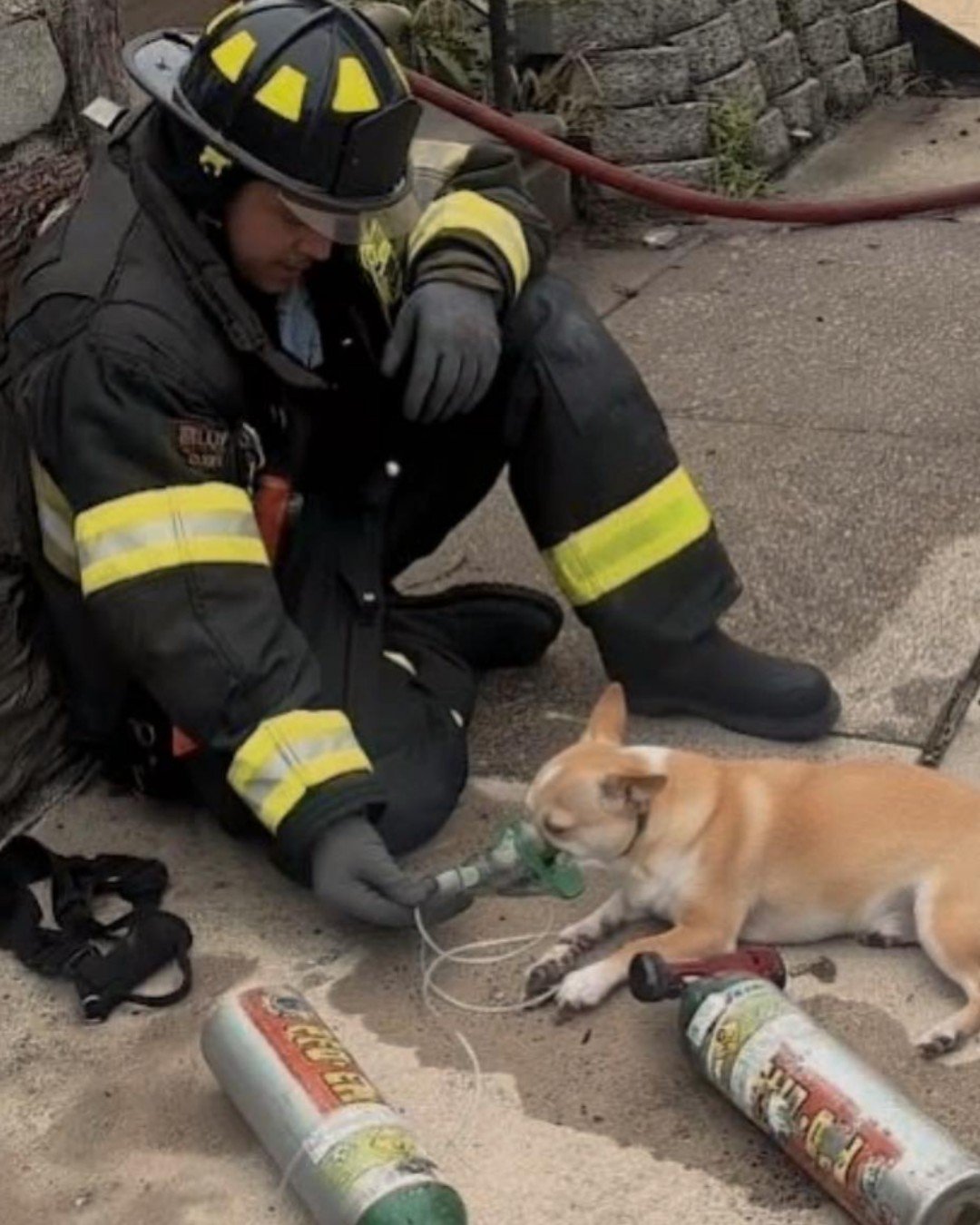
Outside, the fire raged on, but the Chihuahua was alive, shivering in Daniel’s arms. He set the little dog on the ground, brushing soot from his fur. The Chihuahua looked up, eyes wide with awe and relief, and wagged a tiny tail, a gesture that seemed impossibly brave for something so small. Daniel sank to his knees, chest heaving, smoke and tears mingling on his face. He knew he had broken protocol, risked his career, and possibly more—but none of that mattered. One life had been spared. One soul had been saved.
Word of Daniel’s actions spread quickly through the department. Some praised his courage, calling it an inspiring story of human compassion. Others frowned at his insubordination, reminding him of the rules and the dangers he had ignored. Disciplinary hearings loomed, paperwork and reprimands threatened, but Daniel carried no regret. He understood the truth in its rawest form: a job is replaceable. A life is not.
The Chihuahua, later named Ember by the local animal rescue, became a symbol of resilience. Photos of Daniel, soot-streaked and exhausted, kneeling beside the trembling dog went viral in the community. People were captivated not just by the bravery displayed but by the undeniable bond that formed in those terrifying minutes. It was a heartwarming story, a touching story, and for many, an inspiring story of moral courage that transcends protocol.
In the days that followed, Daniel’s colleagues approached him cautiously, unsure whether to celebrate or admonish. Some clapped him on the shoulder, whispering admiration, while others gave curt nods, their faces unreadable. But Daniel paid little attention. Every time he looked at Ember, curled in a blanket beside him in the firehouse, he felt a sense of fulfillment that no commendation or paycheck could provide.
The bond between firefighter and dog grew quickly. Ember, once timid and wary, now followed Daniel through every training exercise, always staying close, always trusting. The little dog became more than a companion; he became a living testament to the choice Daniel had made, a reminder that courage sometimes means stepping beyond rules and routines, and that heroism often manifests in the quietest, most intimate acts of love.
Community support poured in. Local schools invited Daniel to speak about fire safety, and he would always begin by telling Ember’s story. “Sometimes,” he said to wide-eyed children, “doing the right thing isn’t always the easiest. But saving even one life can make all the difference.” His words resonated, sparking a wave of kindness and awareness. Ember sat patiently at his side during every talk, occasionally nudging him or wagging his tail, a living emblem of hope.
The department eventually acknowledged Daniel’s courage officially, though the shadow of insubordination remained. Yet, for him, accolades were secondary. The real reward lay in seeing Ember chase after sticks in the training yard, ears flopping, tongue lolling in pure joy. It was a daily reminder that love, trust, and bravery are measured not by awards but by impact—the difference between life and loss.

Months later, a journalist who had followed the story asked Daniel if he would do it all over again. Daniel smiled, thinking of the smoke, the heat, the fear, and the soft trembling of Ember under the table. “Absolutely,” he said without hesitation. “The rules can be written, and jobs can be replaced, but the lives we touch—they stay with us forever.”
Ember thrived, and together they became a living, breathing lesson in resilience. Their story spread beyond the city, touching hearts everywhere it was told. Fire departments shared the tale as a beacon of compassion, families spoke of it around dinner tables, and children whispered about it at bedtime, imagining a tiny dog saved from the brink of disaster by a man who chose humanity over protocol.
Yet, as Daniel and Ember sat quietly one evening, watching the sun dip below the horizon, both exhausted and content, Daniel felt the familiar twinge of anticipation. Life is never without danger, and heroism is never without choice. The next call could come at any moment, and another life might hang in the balance. But this time, he knew one thing for certain: when faced with the impossible, he would always choose to act, to reach beyond fear, and to protect those who cannot protect themselves.
Because in the end, every heart saved—whether human or canine—is a story worth living, a life worth the risk, and a moment that can change the world in ways no one can predict.